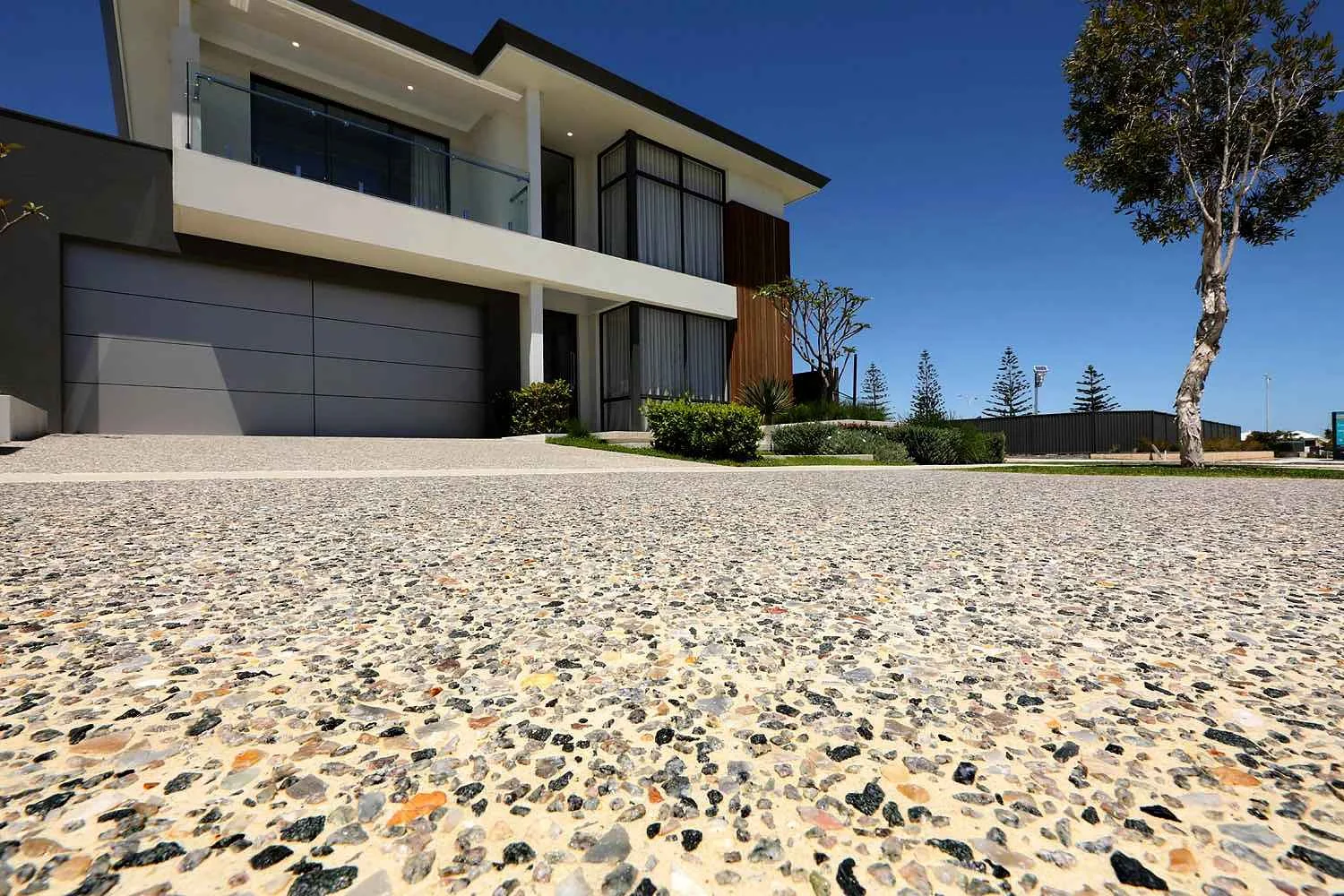
Yes, it can. New paving can send stormwater straight into the yard next door if the falls and drains aren’t planned before the pour.
Concrete doesn’t soak up rain. Every drop that lands on a new driveway, patio or path has to go somewhere. In Victoria, if that water flows onto a neighbour’s property in an unreasonable way, the property owner is responsible. It doesn’t matter that a contractor built the paving. Most paving jobs don’t need a council permit, so nobody checks the drainage until the first big storm.
The good news is that this problem is easy to prevent. It just has to be solved at the quoting stage, not after a neighbour knocks on your door. This guide covers the rules, the drainage options and the questions to ask your concreter before you pour.
Key takeaways
- In Victoria, a property owner can be liable under section 16 of the Water Act 1989 for an unreasonable flow of water onto a neighbour’s land, even when a contractor built the paving.
- Water that crosses a boundary because of the land’s natural slope is generally not the owner’s liability. Water redirected by new paving can be.
- Most paving doesn’t need a council permit, so drainage only gets checked if the owner and concreter plan for it.
- Paving must slope away from the house, so it needs a drain to stop that water heading toward the boundary instead.
- Collected stormwater must go to the council’s legal point of discharge, and a licensed plumber makes that connection.
Can your paving legally send water onto your neighbour’s property?
Not if the flow is unreasonable. Under section 16 of the Water Act 1989 (Vic), a property owner can be liable when water flows from their land and causes damage next door.
The law treats natural flow and redirected flow differently. Rain that crosses a boundary because of the land’s natural slope is generally nobody’s fault. Paving changes that. Once a hard surface collects and redirects water, the flow is no longer natural.
Negligence isn’t the test. The Victorian Civil and Administrative Tribunal (VCAT) looks at whether the flow was unreasonable, not whether the owner was careless. That means hiring a contractor doesn’t move the liability off you.
Councils won’t step in either. Most paving doesn’t need a council permit, so runoff from new concrete is treated as a civil matter between neighbours. If the flow is found to be unreasonable, the owner may have to fix the problem and pay for the damage.
Why does new concrete cause runoff problems next door?
Concrete doesn’t absorb water. Rain that once soaked into lawn now runs straight off the surface, faster and in larger volumes.
The building rules add to the problem. Paving must slope away from the house to protect the slab. If nobody plans where that water goes next, it heads sideways toward the fence.
Coverage matters too. A small path sheds a little water. A fully concreted backyard can send an entire storm’s worth of rain toward one boundary.
Why are Melbourne blocks more at risk?
Much of Melbourne sits on reactive clay soil. Clay absorbs water slowly, so runoff sits on the surface and travels further.
Newer estates add tight boundaries. Houses sit close to the fence, which leaves little ground for water to soak into. Anyone planning landscaping in Cranbourne’s newer estates, for example, has very little margin between the paving and the neighbour’s yard.
How much fall does paving need, and which way should it go?
Paving needs enough fall to move water away from the house, plus a planned destination for that water. The national building code sets the first part. The second part is up to the owner and concreter.
The ABCB Housing Provisions require the ground around a slab-on-ground home to slope away from the building. The minimum is 25 mm or 50 mm over the first metre, depending on the surface and the area’s rainfall intensity. Your concreter should confirm which applies to your site.
Direction matters as much as the number. Good falls do three things:
- Move water away from the house
- Avoid sending it toward a boundary
- Lead it to a drain or a soft surface that can absorb it
Flat blocks are the harder case. With landscape design in Keysborough, for example, much of the land is fairly flat. The fall has to be built into the paving, and the water has to be caught at a drain.
Sloping blocks need extra care at the low edge. If your yard falls toward a neighbour, a drain across the bottom of the paving is essential.
What drainage should be built into your concrete job?
Most jobs need a combination of a channel drain, edging and a soft surface. The right mix depends on your block’s slope and how much area is being paved.
| Option | What it does | Best for | Relative cost |
| Channel drain | Catches water across or along the paving | Driveway ends, low edges, flat blocks | Medium |
| Concrete edging or kerb | Stops water crossing toward the fence | Paving that runs close to a boundary | Low |
| Permeable strip or garden bed | Absorbs runoff into the soil | Backyards with room for planting | Low to medium |
Channel drains
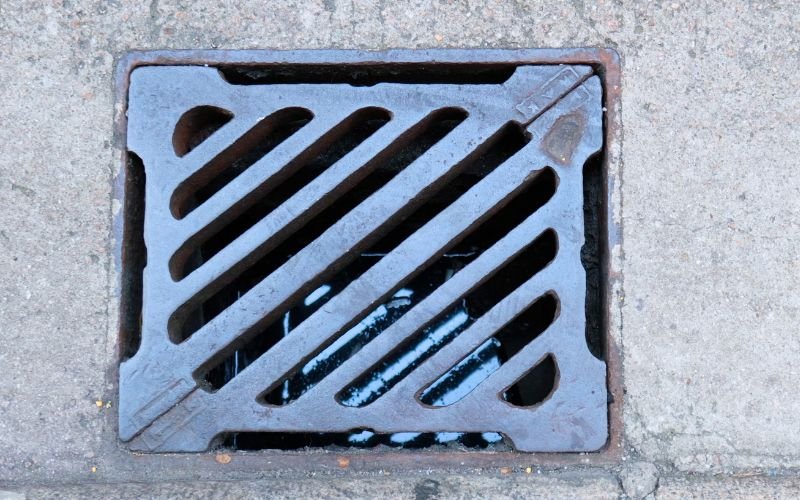
A channel drain is a long, narrow grated drain set into the concrete. It catches water before it reaches a boundary, garage or house wall.
Installation quality decides whether it works. The channel needs full concrete encasement to hold its strength. On driveways, the grate must be load-rated for cars.
Do you need a drain at the bottom of your driveway? If the driveway slopes toward the garage, the house or a boundary, yes.
Concrete edging and kerbing
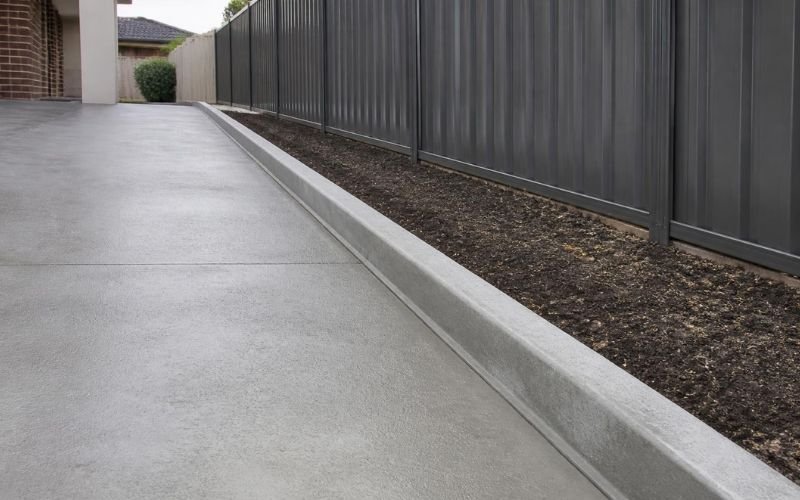
A raised concrete edge along the fence line stops water spilling next door. It works by redirecting water, not removing it. Edging should always lead to a drain or a planted area.
Permeable strips and garden beds
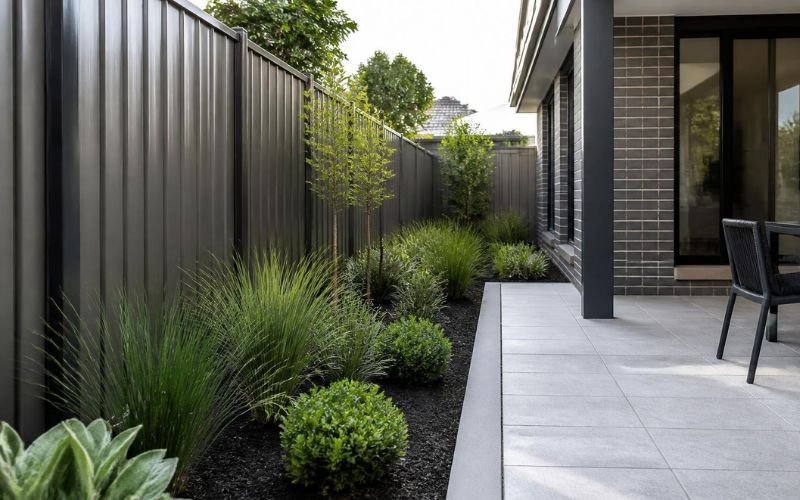
A planted strip along the fence gives runoff somewhere to soak in. It also softens the look of a large concrete area. If you’re planning landscape design in Cheltenham or any suburb with compact backyards, a garden bed between the paving and the fence can do drainage work and visual work at once.
Who connects the drains: your concreter, plumber or council?
Each party handles a different part. The concreter installs the falls, edging and channel drain. A licensed plumber connects the drain to the stormwater system. The council nominates where that water must end up.
That end point is called the legal point of discharge. It’s usually a drain in the street, a kerb outlet or a drain in an easement. Victorian owners are legally required to connect their stormwater drainage to it.
A new paved area can trigger paperwork. If the work alters your existing stormwater system, you may need a legal point of discharge report and consent from council.
Responsibility splits at that point. The owner is responsible for drainage up to the legal point of discharge. Council is responsible beyond it.
What should you ask your concreter before the pour?
Drainage belongs in the quote, not the fix-up. Ask these questions before you sign:
- Where will the water go when it rains?
- Which way will the paving fall, and by how much?
- Is a channel drain included, and where will it sit?
- Will any water head toward a boundary?
- Is the drain outlet set at a level a plumber can connect to?
- Is drainage itemised in the quote, or just assumed?
If a concreter can’t answer the first question clearly, treat that as a warning sign.
Already poured? How to fix runoff going next door
Most runoff problems can be fixed without removing the whole slab. Start by talking to your neighbour. Agreeing on the problem early keeps costs and tension down.
Common fixes include:
- Saw-cutting the concrete to fit a channel drain along the low edge
- Adding a concrete edge or kerb to redirect water
- Replacing a strip of concrete with a garden bed
- Re-laying a section of paving with the correct fall
If you and your neighbour can’t agree, the Dispute Settlement Centre of Victoria offers free mediation before anything reaches VCAT.
Plan the water before you pour
Stormwater runoff from paving is one of the easiest neighbour disputes to prevent. The fix is to plan the falls, drains and soft surfaces before the concrete goes down. Once the slab is poured, every change costs more.
At MNJ Concreting & Landscaping, drainage is part of the quote, not an afterthought. We plan where the water goes before we pour. We can also pair your new driveway, patio or path with garden beds that absorb runoff. That keeps your paving, your home and your neighbour’s yard dry.
Planning new paving? Talk to us before you pour.
Planning a new driveway, patio or path?
Get the falls and drainage right from day one. MNJ plans where the water goes before we pour, so your paving never becomes your neighbour’s problem.
Get a free quote